Wednesday, February 2, 2011

Snow Day

Although my student status technically remains, as I am not yet gainfully employed or anything normal like that, I no longer function as a student in the classic sense of going to class, writing papers, and taking tests.  No, no, I am now done with that.  Now I am essentially “playing house” as a speech pathologist, tagging along with a real speech path in a public school, working with students, dabbling in the paper work, and trying to soak up every last bit of knowledge I can before I am expected to fend for myself (and get a pay check).  Unfortunately, I am essentially paying tuition to work 40 hours a week, but there are some bonuses that come with it.  Like free time at night and on the weekends.  That is huge.  And even better: snow days!

On Monday afternoon, I received the information that school was cancelled for Tuesday.  Imagine my elation of having a surprise mid-week mini break, when the bona fide weekend had ended not even 24 hours earlier.  School was cancelled due to extreme cold temperatures, basically because children can’t be expected to wait for the bus with a wind chill of 35 below zero.  Some criticize this decision, but I have no complaints.  I prefer children to be safe (and time off). 

That evening, I went out for a drink to celebrate, but I immediately started plotting and scheming the perfect menu for frigid temperatures.  It had to involve the oven blaring at high temperatures for a few hours.  My apartment is poorly insulated, and thus quite cold (I am currently wearing wool socks, two pairs of pants, 2 shirts, and a scarf).  Not surprisingly, my ancient oven is also poorly insulated, and it not only cooks food, but it belches heat out into the apartment.  It’s great for winter, not so great for summer, but summer is not of great concern right now.   

Alas, I decided to make lemon-dill roasted drumsticks, which I find so comforting.  My love of chicken on the bone runs so deep that it is slightly disturbing.  In hindsight, brisket would have been a good choice since it takes at least 4 hours in the oven, not including preheating time, but I spent too much time out of the house to pull it off.  So, after fighting through the wind and cold to Whole Foods to get my chicken (8 drumsticks), I whipped up a marinade, consisting of loads of fresh lemon zest and juice (2 lemons to be exact), about 3 tablespoons of finely chopped fresh dill, 2 tablespoons Dijon mustard, a heaping teaspoon of honey, about 3 tablespoons of olive oil, a generous shake of Lawry’s seasoned salt, and freshly ground fresh pepper.  I whisked the ingredients together, and put the mixture and the chicken into a large Ziploc bag to marinate for an hour or so.  (See picture below, and try not to be too grossed out by the raw chicken). 
In the meantime, the oven was preheating, and heating my apartment, set to about 400 degrees (375 would probably do on a functional oven).  After they marinated, the drumsticks went into a foil-lined pan with an extra dusting of Lawry’s and pepper, and into the oven for about 45-50 minutes.  I like to rotate the pan occasional for even cooking. 
While the chicken became browned and blistered in the oven, I proceeded to make one of the coziest side dishes known to man: risotto-style orzo pasta.  It consists of orzo, delicate, rice-shaped pasta, cooked slowly in chicken stock so that it releases its starches to make the end product creamy and luxurious.  The chicken stock makes it so flavorful, and onions sautéed in butter at the start of the dish don’t hurt the flavor factor either.

First, sauté a half of an onion, diced, in 2 tablespoons of butter over medium heat for about 10 minutes, until the onion is soft, but not browned.  Season the onions liberally with salt and pepper at the start of cooking, and stir frequently. 
Then add 1 cup uncooked orzo pasta, stirring for about one minute until it is evenly coated with the butter, and starting to toast a bit. 
Then add two cups of chicken stock (I buy one 14 oz. can of stock and make up the difference with water).  Bring the mixture to a low simmer, then cover, and allow it to cook for 20-25 minutes, stirring occasionally.  You can always add more water if it starts to look dry or too thick (just a tablespoon or two at a time).  When it’s done, douse it with freshly grated Parmesan (about ½ cup) and ¼ cup of chopped flat leaf parsley.  Frozen peas are also a nice touch, especially if you don’t have parsley on hand, but it definitely needs something green at the end.
I served my chicken and orzo with a simple baby arugula salad, drizzled with extra virgin olive oil, a spritz of fresh lemon juice, parmesan cheese, and just because I had it on hand, some fresh dill.  And as if this meal wasn’t delicious enough, I received some news as I was about to start cooking that made it taste even better: I had another snow day the following day!  Please curb your jealousy.  You can simply make this delicious meal, and live vicariously through me. 

Monday, January 17, 2011

Tortilla Soup

My friend, Molly, inspired this simple, lovely recipe.  She is a great cook, and I was lucky enough to eat her tortilla soup recently.  I know I just posted a soup recipe, but January is National Soup Month, and I’ve wanted to make this recipe for a while.  I’m not sure who exactly the qualified authority figure is that delegates these food holidays, but I think it’s a good excuse to inundate my blog with soup recipes.  Plus, avocados make a perfect garnish for tortilla soup, and they just happened to be on an irresistible sale. 

My tortilla soup is very similar to Molly’s soup, the source of its inspiration.  It is made with canned chicken stock, flavored with cumin, onion, bell pepper, and tomatoes.  The soup does not have any meat in it.  Instead, heartiness is added by the creamy texture of black beans and the sweet pop of corn kernels.  Unlike Molly’s recipe, my soup is thickened with white corn tortillas during the cooking process, while she served it with tortilla chips.  Although my method isn’t seen in most recipes, it’s fairly traditional.  The tortillas practically dissolve into the soup, adding body and flavor to the soup.  Once the tortillas hit the hot soup, you can immediately smell the difference, as the corn tortillas heat through and distribute through the pot.  After cooking, some small pieces of tortilla remain, but most disappear into the soup and simply thicken and flavor the soup.
Not only is the soup delicious, but its preparation is very easy.  It only requires some sautéing of vegetables followed by dumping of various ingredients to the pot.  It was a stress-free and relaxing meal to make.  The flavor base is onion, bell pepper, and garlic (I wanted to add a jalapeno, but forgot it in my grocery basket).  After sautéing the vegetables, the majority of the remaining ingredients are essentially dropped into the pot, and the whole thing simmers for a half hour.  This gives you plenty of time to clean up, and prepare the toppings. 
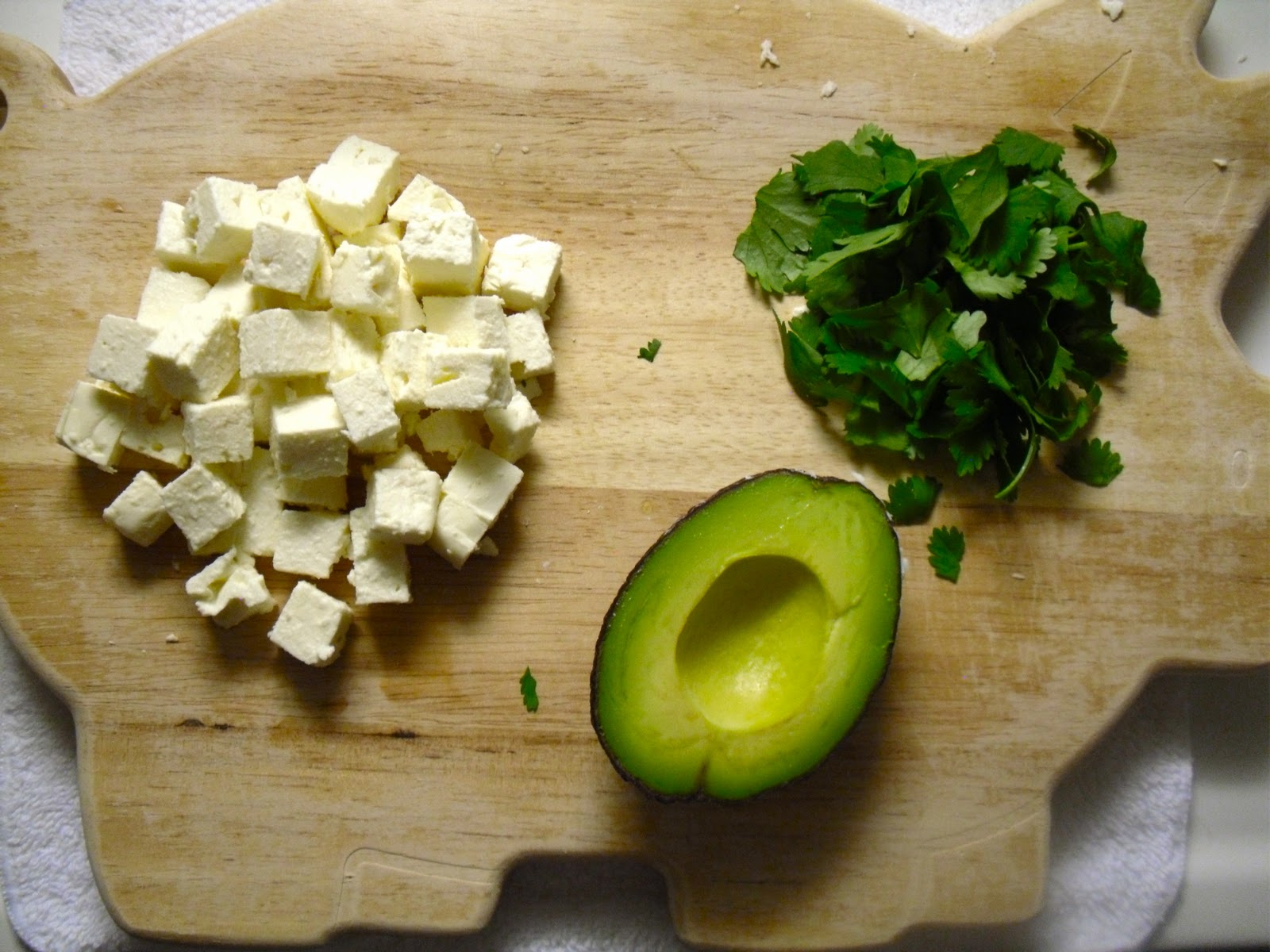
The best part of the soup may actually be the toppings.  Molly served it with a bevy of toppings:  tortilla chips, fresh cilantro, cheese, avocado, and onion.  She even had chopped tomatillos, fresh from her father’s garden.  My toppings were not quite as plentiful, but I followed the same basic idea.  I used fresh cilantro, diced avocado, and cubes of salty feta cheese.  Queso fresco is traditional, but Molly used feta, so I followed her example.  Plus, I love any excuse to eat feta cheese.  This was such an easy and delicious recipe, where the whole somehow exceeds the sum of its parts.  Sometimes, I enjoy cooking dishes that require lots of chopping and preparation, but this making this soup was a relaxing process that made for a hearty and delicious meal on a snowy Sunday night (during National Soup Month, no less).  
          
Tortilla Soup (serves 4-6)

2 tablespoons olive oil
1 onion, chopped
4 cloves garlic, minced
1 green pepper, chopped
Salt, pepper, garlic salt, seasoning salt, to taste
3-14 oz. cans reduced sodium chicken stock
1-14 oz. can diced tomatoes
2 teaspoons cumin
1 teaspoon hot pepper flakes (or to taste)
1 teaspoon chili powder
1 cup frozen corn kernels (no need to thaw)
1 can black beans, drained and rinsed
4 corn tortillas, cut in strips
2-3 tablespoons chopped cilantro.
Possible garnishes: avocado, cheese, sour cream, fresh cilantro, lime wedges

-       In a large soup pot, preheat the olive oil over medium heat.  Add onion, bell pepper, and garlic to pan.  Season to taste with salt and pepper (I used about a half teaspoon of each), and sauté for 10 minutes, or until vegetables are soft.
-       Add chicken stock, tomatoes, corn, cilantro, cumin, hot pepper flakes, and chili powder.  Increase heat and bring liquid to a boil.  When boiling, reduce heat so that the soup simmers. 
-       Add tortillas and black beans.  Cook for 20-25 minutes, stirring occasionally, until soup starts to thicken and tortillas break down.
-       Taste for seasonings and adjust as needed.
-       Serve soup and garnish as desired.

Thursday, January 6, 2011

Matzo Ball Soup

New Year’s Eve, 2010: the close of a remarkable year.  When I say “remarkable,” I mean it in the truest sense of the word, meaning striking, noteworthy, and worthy of attention.  I have been blissfully happy, stressed, inspired, disenchanted, and utterly devastated.  I have been to a wedding, and a funeral.  And it has now come to a close.  I have been accused of being a contrarian before, and while I am not certain that this shoe fits me in general, it definitely fits when it comes to New Year’s Eve.  To me, New Year's Eve is a recipe for disappointment:  over-crowded bars with over-priced drinks.  Because it marks the passing of years, it necessitates some sort of self-reflection, for which crowds of strangers are not conducive.  So, what do these negative opinions make me?  A party pooper.  And no better way to embrace my true party pooper self than to stay in on New Year’s Eve, and do some cooking to tend my wounds.

New Year’s Eve cooking provides the opportunity for leisurely, slow-simmering recipes.  I chose soul-soothing matzo ball soup, and indulged in all possible steps to make it as flavorful as possible, drawing out the process simply because I had the time to.  Honestly, what else is a party pooper going to do on New Year’s Eve when it is 10 degrees outside?
The first thing I did was prepare the tender little matzo balls.  If you’ve never had a matzo ball, it is sort of like a bland meatball made entirely with cracker meal.  I suppose it may be called a Jewish dumpling, comprised of matzo meal and a little oil, bound together with eggs.  They are tender, bland, and comforting.  Matzo balls are simmered in salted water, which results in random salty bites.  The whole process takes about 45 minutes, and it is largely unattended.  The easiest thing you can do is to go the kosher isle of the grocery store and pick up a box of matzo ball mix, then follow the instructions exactly.  It’s pretty simple.  Most importantly, do not, under any circumstances, lift the lid off the matzo balls as they simmer.  This will make them tough.  This advice has been passed down from my late grandmother, and must be heeded.  My grandma was not exactly known for her culinary prowess; she had a habit of  mixing any and all lingering beverages in the fridge into one cesspool of leftover liquids (juices, soda, anything).  However, the woman knew her matzo balls.  
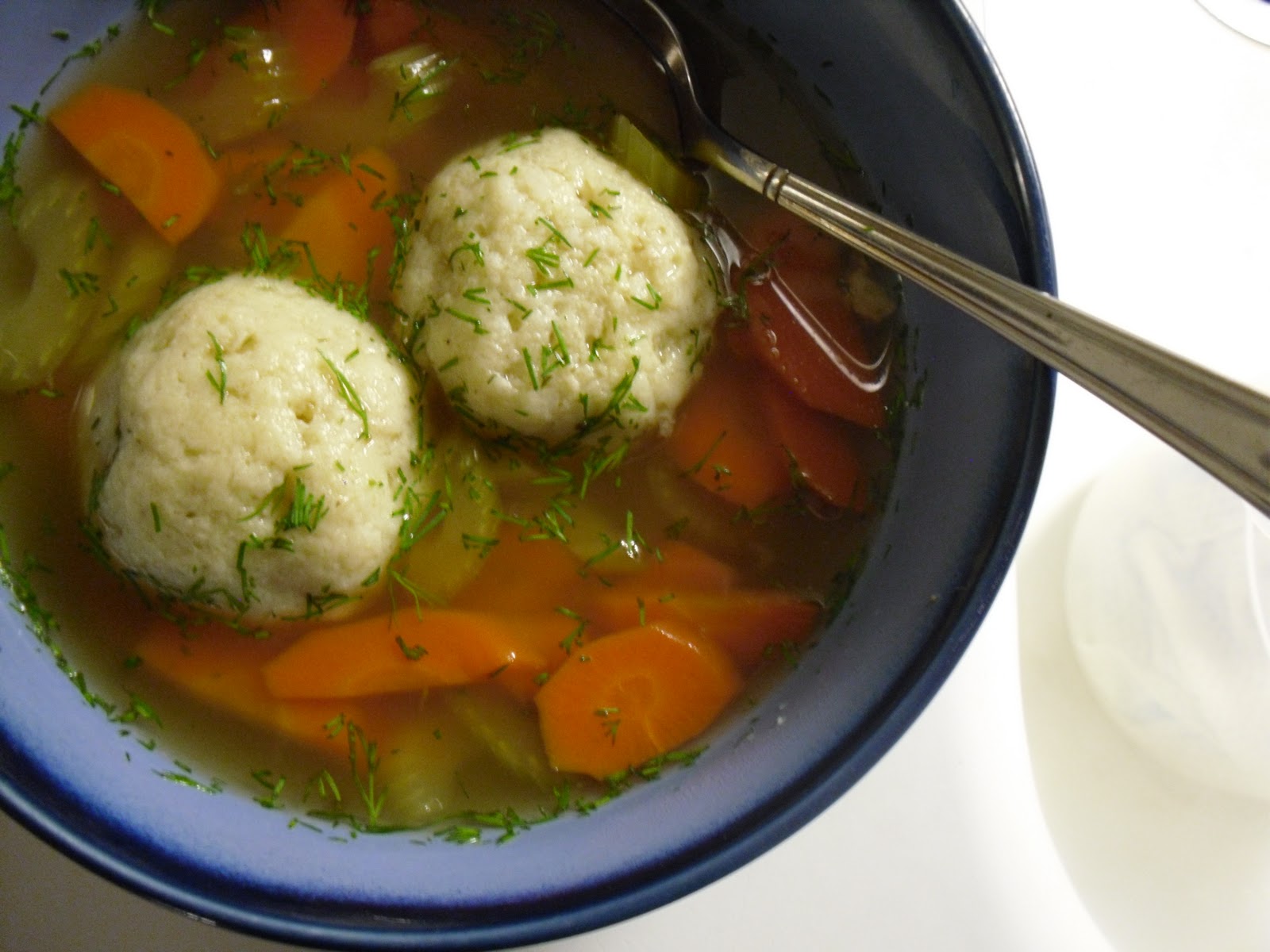
Essentially, you mix one packet of matzo meal with 2 lightly beaten eggs and 2 tablespoons of vegetable oil.  Let this sit in the refrigerator for 15 minutes, and then roll the mixture into 1 inch diameter spheres.  Next, drop the them into boiling, salted water, and put a lid on the pot.  Reduce the heat to a simmer, and leave the pot alone for 20 minutes.  Anyway, if you follow these instructions or the one on the box, you should have matzo balls that look something like the picture above.  They will be tender and fluffy, yet substantial.  They are sort of like lumps of bread that can stand up to soup.  Furthermore, matzo balls can be made in advance and await your spoon in the fridge.  I made mine in the morning, but I don’t see why they couldn’t be made a day in advance.  
Next, I proceeded in making a delicious broth.  I did not make it from scratch, and instead fortified canned chicken stock with aromatic vegetables and herbs.  I used carrots (3 cut in thirds), celery (3 stalks cut in thirds), 1 onion (peeled and halved), 6 whole garlic cloves (peeled), fresh dill sprigs, and lots of black pepper.  All of these lovely vegetables took a leisurely bath in 4 cans worth of simmering chicken stock (with one cup water added).  This step of simmering vegetables is not necessary, but it adds richness to the stock, makes your apartment smell amazing, and it’s fun (at least that is my personal belief).  Simply add the aforementioned vegetables in large chunks and let the broth simmer away for an hour or so.  Cover the soup during this process, but vent the lid, and stir the broth occasionally.  When the vegetables are very tender, and they have relinquished their fresh flavor, remove them with a slotted spoon.  You can discard them, or enjoy them as a snack.  I always leave the garlic cloves in soup because I love them.  If you've never had slow-cooked garlic cloves, they may surprise you.  After all of that cooking, they become incredibly soft and lose their pungency.       
If you skip the previously discussed stock fortifying step, do not fear.  You will still have delicious soup.  Use the same amount of broth and add 4-5 thinly sliced carrots and 3 thinly sliced stalks of celery.  Pepper, dill (fresh or dried), or dried parsley are all nice additions.  In fact, treat your soup in this manner whether you have skipped the step above or not.  According to Marc Bittman, traditional matzo ball soup is served only with carrots, but celery was always in the mix at my family dinner.  Once you add the sliced carrots and celery, simmer for about thirty minutes to an hour so that the fresh vegetables may cook to your texture specifications.  Allow the soup to cook uncovered at this point so that the broth will reduce, and deepen in flavor. 
When you are ready to eat, add the matzo balls to the soup (they warm quickly, and I do it per each bowl).  Perhaps sprinkle some fresh dill on top.  With this soup, you now are ready to soothe your soul, even if it’s only a temporary measure.  That is, until you go back for seconds.    

Thursday, October 14, 2010

Cream of Mushroom Soup

I suppose there will be an ebb and flow of emotions with anything you love, and I have been experiencing low tide regarding both my creativity and enthusiasm for cooking.  Unfortunately, my stove has been as barren as my blog; however, I am hoping that dropping temperatures and decreasing daylight will reignite my interest, as my favorite comfort foods become increasingly appropriate (there should be something positive to glean out from these first glimpses of winter).
Soup is a universally loved cold-weather comfort food, and this soup is a mushroomy masterpiece.  If this mushroom soup had a motto, it would be “go big or go home.”  It has two pounds of fresh mushrooms, plus dried porcinis, which are added to sautéed onions and garlic.  This may sound a bit excessive, and when you first add them to the pot, you may think you have done something seriously wrong, as your aromatics become overwrought by sliced shrooms.  Do not fear: mushrooms contain a lot of liquid, and they will shrink significantly as they sauté.  They will also lead to unparalleled mushroom flavor, accented by fresh rosemary.  The original recipe called for both fresh sage and fresh rosemary.  In an effort to streamline and save myself a couple of bucks, I chose to add rosemary alone.  After all, mushrooms and rosemary play so nicely together that I figured the single herb should suffice.  The meaty savoriness of mushrooms stands up assertively to rosemary’s piney, earthy warmth.  Essentially, the onion, garlic, rosemary, and mushrooms are simmered together with some stock, and finished with heavy cream.  It’s just half a cup, so don’t do something lame, like replace it with skim milk.  Before I added the cream, I snuck a little sample of soup, and it was so meaty and savory that I questioned adding it for about a millisecond.  But I forged on, heavy cream in hand, and the difference it made was completely invaluable.  There is something about saturated fat that simply brings out the best in things.  As with most cream of mushroom soups, this one is inevitably blended, but please do so with caution, and leave some chunks of mushrooms.  After all of that time cleaning and slicing, it would be a crime to pulverize them.  
Cream of Mushroom Soup (adapted from Smitten Kitchen)

3 tablespoons olive oil
1 large onion, chopped
3 garlic cloves, minced
2 sprigs fresh rosemary
Kosher salt
Fresh ground pepper
½ oz. dried porcini mushrooms
1 cup very warm water
1 lb. white button mushrooms, sliced
1 lb. cremini mushrooms, sliced
2-14 oz. cans reduced sodium chicken broth
1-14 oz. can beef broth
½ cup heavy cream

-       Steep dried mushrooms in 8 ounces of very warm water for 20-30 minutes.  When mushrooms are plump, lift them from the water (leaving as much grit behind as possible), and coarsely chop them.  Strain soaking liquid through a coffee filter to remove grit (I actually lined a fine mesh sieve with a paper towel, and that worked fine, and so far I’m still alive).  Set aside mushrooms and soaking liquid. 
-       In a large soup pot, head olive oil over medium heat.  Add chopped onions, garlic, rosemary sprigs, 1 teaspoon of salt, and lots of pepper.
-       Sauté for 10 minutes, or until soft and translucent, stirring frequently.
-       Increase heat to high and add all of the sliced mushrooms.  Stirring frequently, sauté for 10 minutes, until mushrooms give off liquid and reduce significantly in volume.  Stir frequently, especially when you first add them to prevent burning.  (You may want to lower the heat initially until the mushrooms begin to release liquid).
-       Add chicken stock, beef stock, reserved mushroom soaking liquid, and porcinis.
-       Allow the soup to simmer (over about medium heat) for 30 minutes.  Remove rosemary sprigs, add cream, and blend with immersion blender until it is the desired consistency.  This could also be done in a blender, but be sure to do it in batches, with the blender about half full and vented.
-       Keep soup at a bare simmer (to prevent cream from curdling), and serve soup with good bread and extra virgin olive oil.  

Sunday, September 5, 2010

Marinara Sauce with Fresh Tomatoes

It’s no secret that psycho cooker is psycho for pasta.  It is just so tasty and versatile, not to mention affordable.  Of all the ways to cook pasta, there are few that are as pure and classic as marinara.  I have no qualms about using canned tomatoes, or even cracking open a good jarred brand.  However, making it from scratch with fresh tomatoes elevates this simple pleasure to a new elegance, and there is no better time to tackle such an endeavor than late summer, when tomatoes achieve their deepest color and flavor.


Fresh marinara is not a quick feat, and while it is not difficult, there are a lot of steps, and it requires some organization.  The recipe requires that Roma tomatoes be blanched, peeled, and seeded, which is less difficult than it sounds, but takes a good half hour to forty-five minutes.  What does this mean exactly?  Score all the tomatoes, by using a paring knife and making an X in the bottom of each one.  Then drop them into boiling water for about 20 seconds.  The tomatoes go promptly from the boiling water to a bowl of ice water for about a minute to cool down (this is called “shocking” the tomatoes, and I imagine that, as a Roma tomato, it would indeed by quite shocking).  After removing them from the ice water, the skins of the tomatoes will easily slip off with a gentle tug.  You can then remove the majority of the seeds by slicing each tomato in half and gently squeezing the halves in the palm of your hand.  This process may sound like nuisance; I personally find it incredibly comforting.  To each him own, but if you find yourself siding with the prior statement, the recipe could also be made with a large can of whole peeled plum tomatoes, and a significantly decreased cooking time. 
Marinara requires diced aromatic vegetables as its flavor base.  I recommend chopping the aromatics (onion, carrot, celery, and garlic) first, while a BIG pot of water comes to a boil for blanching the tomatoes (the water can be used again later to boil the pasta).  Chopping these vegetables in advance and setting them aside will make the whole process smoother, and it will only require a few extra minutes (we can all come up with 10 extra minutes, right?)  You could skip the carrot and celery, but I think they add a nice dimension, and balance the tomatoes’ acidity.
Did I mention how delicious this sauce is?  I let it cook for about 50 minutes, of course tasting it along the way.  It retained the flavor of raw tomatoes for so long that I was getting a little concerned, but something magical happened in the last 10 or minutes of cooking; all the flavors came together to yield a rich, deep, slow-simmered tomatoey flavor.  I gave mine a blitz with my immersion blender to make it smooth and silky.  This is not necessary, especially if you like a chunky sauce, but it also helps create the creamy color.  Despite the color, there is actually no cream in this recipe.  That is just the natural pigment of the fresh tomatoes, and I can practically guarantee that your sauce will have the same lush color.  In a world with so much chaos, it is certainly a comfort to know that simple, raw ingredients can be transformed into something so much greater than the sum of their parts with a little thought and organization, and of course, heat.  You can always rely on good, old chemical reactions.     
This recipe yields about 5 cups of sauce.  What to do with the leftovers?  Freezing it is a good option, but I have a more delicious idea.  Stay tuned (hint: it involves crispy, breaded chicken and melted cheese).   

Fresh Tomato Marinara (yields about 5 cups)

¼ cup extra virgin olive oil
3 lbs. ripe Roma tomatoes
1 medium onion, diced
1 carrot, peeled and diced
1 stalk celery, diced
4 cloves garlic, minced
2 tablespoons tomato paste
1 teaspoons dried oregano
Hot pepper flakes, to taste (optional)
1 teaspoon sugar
Kosher salt and freshly ground black pepper
½ -1 cup chicken stock, vegetable stock, water, white wine (optional)

Serving suggestion:
Freshly cooked pasta, Parmesan cheese, chopped parsley or basil

-       Dice the onion, carrot, celery, and garlic set aside. 
-       Put a large pot of water over high heat to come to a boil.  You want it to be large enough to boil your pasta.
-       While the water heats up, rinse the tomatoes, and score them on the bottom, making an X.  Use a paring knife to do this and try not to cut too deep into the tomato.  Also, set up a large bowl of ice water.
-       When the water is boiling, add about 3 tomatoes at a time with a slotted spoon, and let them boil for 20 seconds.  Remove from the boiling water, and add to the ice water.  Allow the tomatoes to sit in the ice water for one minute, and then set aside.  Repeat until all tomatoes have been blanched and chilled.
-       In a three-quart sauté pan (or larger – definitely not smaller), heat the olive oil over medium heat.  Add chopped vegetables and garlic.  Season with a big pinch of salt (about a teaspoon), pepper, and add the oregano and hot pepper flakes (if using).  Sauté until soft, stirring frequently, about 12-15 minutes total.
-       While the vegetables cook, pull the skins off the blanched tomatoes, and cut each one in half.  Place a tomato half in the palm of your hand, cut side up.  Gently the tomato gently into a fine strainer, lining a large bowl.  Squeeze each tomato half until the majority of the seeds come out, and set the tomatoes aside.  When you are done with all the tomatoes, push the pulp through the strainer with the back of a large spoon. 
-       Coarsely chop the peeled and seeded tomatoes, removing any large white cores.
-       When the vegetables have softened, add the tomato paste, and stir to combine (some chunks of tomato paste are okay), and then add all of the tomatoes and any strained juice from the seeding process.
-       Add more salt and pepper, a teaspoon of sugar, and stir to combine.  Increase heat so the sauce is gently bubbling.  Put a lid on the pot, but keep it vented.  Stir occasionally, and allow the sauce to simmer for 45 minutes to an hour.
-       If you’re sauce looks like it has reduced a lot, but it still has a raw tomato flavor (e.g it’s not done), and requires more cooking, add some liquid (½ to 1 cup).  I used chicken stock, but water, wine, or vegetable stock would work too.
-       When your sauce tastes and smells delicious (taste it for seasoning), you may want to give it a blitz with an immersion blender, but don’t obliterate it.  You could also do this with a standing blender.  I would recommend only blending about half the sauce so you maintain some texture, and make sure you don’t fill your blender more than half way, and vent it, to prevent explosions.
-       Toss your sauce with freshly cooked pasta and lots of delicious Parmesan, and maybe a little parsley.  Be sure to set aside some pasta cooking liquid before draining your pasta to help bind everything together.  A little extra virgin olive oil at the end is also delicious.  (By the way, unless you're cooking for a really big crowd, be sure to set a couple of cups of sauce aside for other applications.  Always better to set aside too much than too little.  It goes back into the pasta a lot easier than it comes out.)